



Stop Experimenting.
Start Operating with AI.
Connect your systems. Centralize your logic. Automate mission-critical operations







A decade ago, IT teams fought a familiar enemy: Shadow IT. Employees stored files in personal Dropbox accounts, shared data via spreadsheets, and collaborated on unsanctioned messaging platforms. The risk was visible, manageable, and eventually contained.
Today, a far more complex challenge has emerged.
Welcome to the era of Shadow AI.
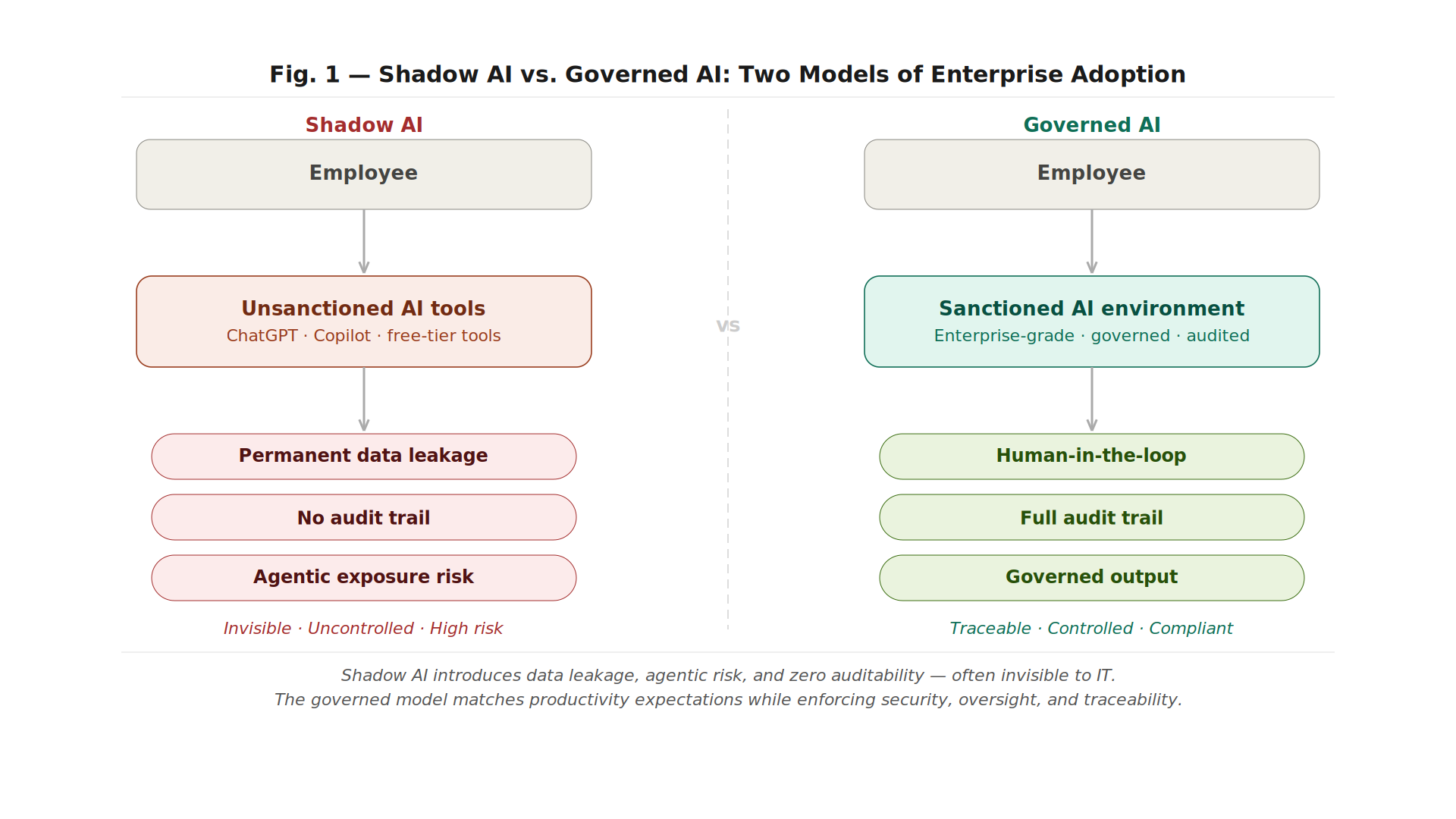
Shadow AI refers to the use of artificial intelligence tools such as ChatGPT, Copilot, or autonomous browser agents without the knowledge, approval, or oversight of an organization’s IT or security teams.
These tools are often adopted informally by employees who want to work faster and smarter. But unlike traditional Shadow IT, Shadow AI doesn’t just store data. It consumes, transforms, and acts on it.
That distinction changes everything.
Generative AI adoption has exploded. By 2024–2025, nearly 96% of enterprise employees are using AI in some form as part of their daily work. At the same time, more than 60% of organizations still lack a formal AI governance policy.
Employees are not acting in bad faith. They use AI to:
The problem arises when official corporate AI tools are perceived as too slow, too limited, or too restrictive. Employees then turn to personal accounts and free-tier tools that offer speed but no enterprise-grade security, privacy, or auditability.
Shadow AI introduces a new class of risk, one that is deeper, faster, and harder to detect.
1. Permanent Data Leakage
When sensitive data is entered into consumer AI tools, it may be retained or used for model improvement. Once exposed, that information cannot be recalled. Intellectual property, legal documents, or source code may effectively become part of the broader AI ecosystem.
2. Agentic AI and Autonomous Actions
Modern AI agents can take actions on behalf of users. Unsanctioned browser extensions or copilots may have permission to read emails, modify systems, or interact with enterprise applications, often without clear visibility into what actions are being performed.
3. Indirect Prompt Injection
Attackers can embed malicious instructions inside emails, PDFs, or documents. When an AI agent processes this content, it can be tricked into leaking data or executing unauthorized actions without the employee ever realizing it.
Shadow AI is not limited to junior employees. In fact, executives and managers are among the most frequent users of unsanctioned AI tools. Under pressure to deliver results, they often bypass IT safeguards to access the latest capabilities.
This creates a dangerous imbalance:
those with the most sensitive access are often using the least governed tools.
Banning AI is not a viable solution. Prohibition only drives usage underground, where it becomes invisible and unmanageable.
Leading organizations are shifting toward a “Guardrails, Not Gateways” model:
Shadow AI is not a failure of employees. It is a signal that the workforce is asking for a new way of working. The real risk lies in ignoring it.
Organizations that succeed in 2025 and beyond will not ignore Shadow AI. They will illuminate it, govern it, and harness it safely.
The future of work is already here.
The question is whether it’s happening in the light, or in the shadows.

Connect your systems. Centralize your logic. Automate mission-critical operations
Connect your systems.
Centralize your logic.
Automate mission-critical operations
