



Stop Experimenting.
Start Operating with AI.
Connect your systems. Centralize your logic. Automate mission-critical operations








The enterprise AI narrative has reached an inflection point.
After years of sustained investment, the impact of AI in large organizations remains narrower than expected. Thousands of employees now use copilots to draft emails, summarize meetings, and polish presentations. These are real productivity gains.
But at the core of the enterprise the processes that move money, manage risk, and coordinate operations very little has changed.
This isn’t because AI models lack capability.
It’s because the environment they run in was never designed for execution.
For decades, the enterprise stack was built around a simple assumption: humans make decisions, software records outcomes.
As a result, organizations invested heavily in systems of record to store what happened, systems of engagement to discuss what happened, and workflow tools to route predefined tasks.
What they did not build was a layer designed to execute decisions across systems.
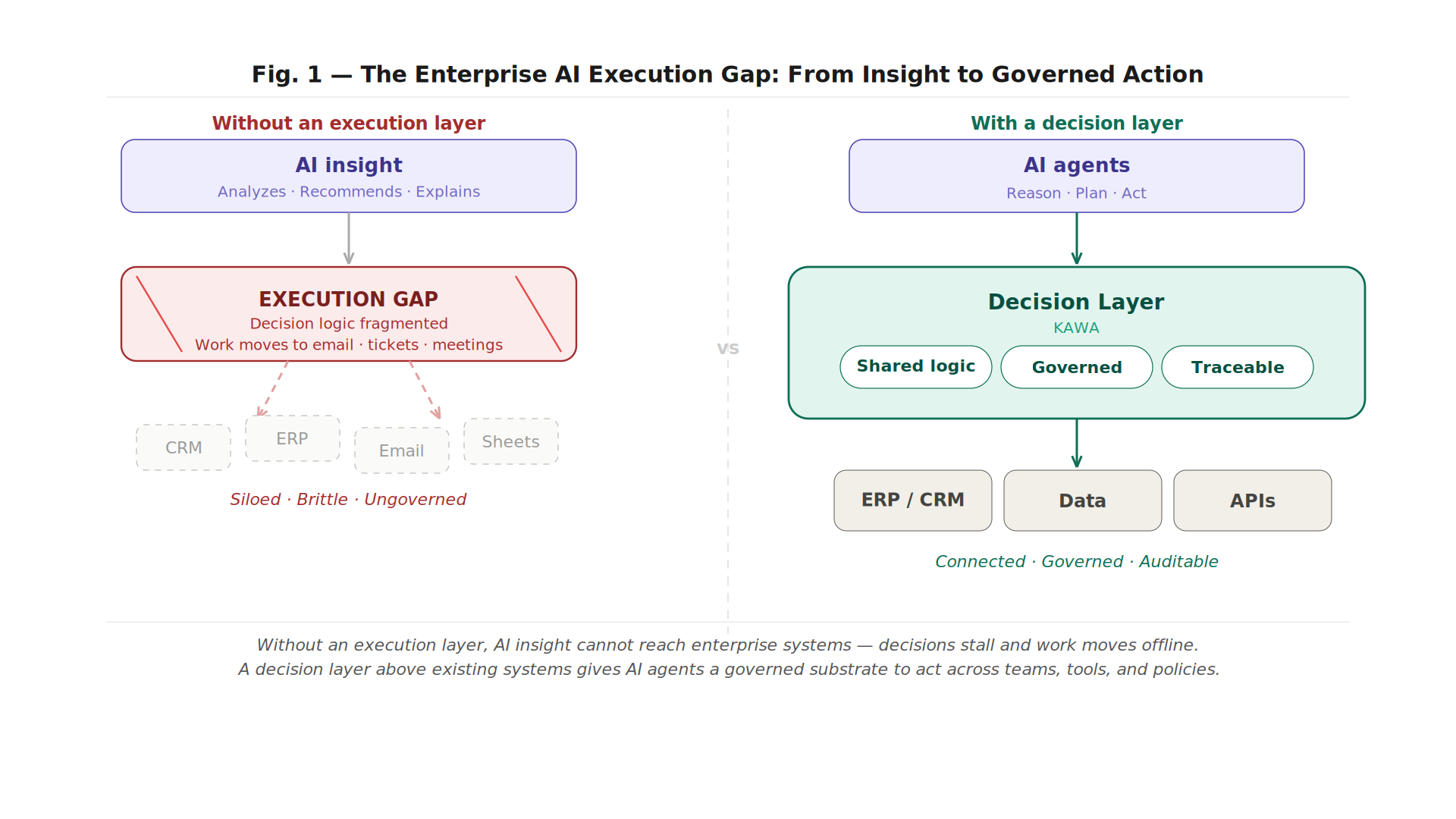
Most enterprise applications remain siloed. Business logic is hardcoded. Integrations are partial and brittle. Actions are constrained to the boundaries of a single tool.
Decision logic itself is rarely treated as a shared, governable asset. Rules are embedded deep in applications. Policies are implicit rather than explicit. Exceptions are handled manually. Each system enforces only a partial view of reality.
Within this architecture, AI can analyze and recommend but execution remains fragile.
This limitation becomes clear when you look at how enterprises really operate.
The work that matters most does not happen inside a single application.
It happens across departments, where ownership overlaps and priorities diverge.
It happens across systems, where the CRM, ERP, and spreadsheet rarely agree.
It happens inside exceptions, where standard workflows break down.
This is where enterprise value is created.
These workflows tend to span multiple teams, cut across several systems, and be constrained by policy rather than simple automation. They are driven by exceptions, not happy paths.
When decisions cross these boundaries, execution slows or stops. Work moves into email threads, tickets, spreadsheets, and meetings. Over time, critical knowledge accumulates in people’s heads rather than in systems.
This informal layer the enterprise’s “shadow stack” is where revenue is protected and risk is managed, yet it remains largely invisible to the software stack.
These are not edge cases.
This is normal enterprise operation.
AI can connect disparate data, understand intent, and reason across uncertainty. In many cases, it can assemble the right answer faster than any human team.
But insight alone does not move a business.
Consider a common order-to-cash exception. A pricing discrepancy appears late in the process. Resolving it requires coordination across Sales, Finance, Operations, and Legal.
AI can surface the issue, gather the relevant context, and suggest a resolution in seconds.
What it cannot easily do is execute that decision across systems, approvals, and policies.
The intelligence is present.
The outcome is unchanged.
AI reasons at machine speed, but execution collapses back to human speed.
As AI moves from insight to execution and agents begin to act on behalf of the enterprise leadership always asks the same questions:
Why was this decision made?
Under which policy?
Who approved it?
Would it happen again?
In many enterprises, there are no reliable answers.
Decision logic is fragmented spread across applications, buried in code, hardwired into workflows, scattered in spreadsheets, and reinforced by undocumented habits. No single system actually owns how decisions are made.
As a result, decisions can’t be fully explained, consistently enforced, or reliably repeated.
That’s where trust breaks and automation stalls not because AI isn’t capable, but because leadership can’t defend its actions to auditors, regulators, or customers.
Human oversight becomes mandatory, not optional.
Until decision logic is explicit, centralized, and governed, AI execution will remain constrained not by technology, but by organizational risk.
For years, this gap was manageable.
AI assisted individuals, and decision volume scaled with headcount. Today, that balance no longer holds.
Enterprises operate with more data, more interconnected systems, tighter regulatory expectations, and faster decision cycles. Human decision-making does not scale with this complexity.
AI can help absorb it but only if execution occurs within clear, enforceable boundaries.
Execution without governance introduces risk.
Governance without execution limits impact.
Reconciling the two requires an architectural shift.
Closing the execution gap does not require better prompts or more copilots.
It requires changing the layer where AI operates.
The workflows that matter most require shared decision logic, cross-system execution, explicit policies, approvals, and traceability. These requirements cannot be met reliably when decision logic remains embedded inside individual applications.
They point to the need for a layer above systems, not inside them.
A decision layer focused on execution provides a place where data comes together, business logic is defined once, decisions are executed through governed workflows, and every action is traceable.
This is how AI moves from explaining work to reliably executing it.
Enterprises don’t have an AI problem.
They have an execution problem.
As long as critical work lives between systems, AI will keep explaining issues faster than it can resolve them. Closing that gap requires treating decision execution as a core part of the enterprise stack not an afterthought.
That’s where durable AI value will actually be created.
KAWA was built for this layer.
It sits above existing enterprise systems, turning data and business logic into governed, executable decisions. AI agents can act across teams and systems always within defined rules, approvals, and access controls.
KAWA doesn’t replace your tools.
It makes execution work across them.

Connect your systems. Centralize your logic. Automate mission-critical operations
Connect your systems.
Centralize your logic.
Automate mission-critical operations
