

Stop Experimenting.
Start Operating with AI.
Connect your systems. Centralize your logic. Automate mission-critical operations








The next wave isn’t smarter models. It’s executed decisions across systems and departments.
Enterprise AI isn’t stalled because enterprises lack intelligence.
It’s stalled because they lack an environment where intelligence can operate across the business.
Most AI deployments today succeed in the same places: writing, summarizing, searching, and answering.
And they fail in the same places too: the workflows that actually run the company.
Not because those workflows are harder to understand, but because they’re harder to execute across systems and teams.
That is why the future of enterprise AI is cross-functional work: where value is created, risk accumulates, and AI either becomes operational or fades into irrelevance.
Enterprises organize themselves around systems and departments, but they don’t break inside them. They break at the handoffs between them.
When work moves from Sales to Finance, from Procurement to Accounts Payable, from Operations to Customer Support, or from Planning to Execution, context is lost, ownership breaks down, and exceptions appear.
This is where the enterprise actually operates, and where humans quietly serve as the integration layer.
AI does not create value by being smarter inside a single tool. It creates value only when it can operate across these boundaries.
For years, the primary limitation of enterprise AI was model capability.
Could AI understand intent, handle ambiguity, and reason across unstructured data?
That is no longer the core problem.
Today, the bottleneck is operational. The central question has shifted to a much harder one:
Can AI execute decisions across departments and systems safely, consistently, and under enterprise policy?
This is the real “why now” moment. Not because models have suddenly become magical, but because enterprises are finally attempting to move AI out of pilots and into real operations and are discovering that their existing operating model cannot support it.
Copilots are undeniably useful. They reduce friction within applications by helping draft content, summarize information, search knowledge, and explain results.
But the enterprise does not operate inside a single UI.
The moment work crosses departments, systems, approval chains, or policy boundaries, copilots lose leverage. They can suggest next steps, but they cannot own resolution.
That is why copilots consistently plateau at the point leaders care most about: cross-functional execution.
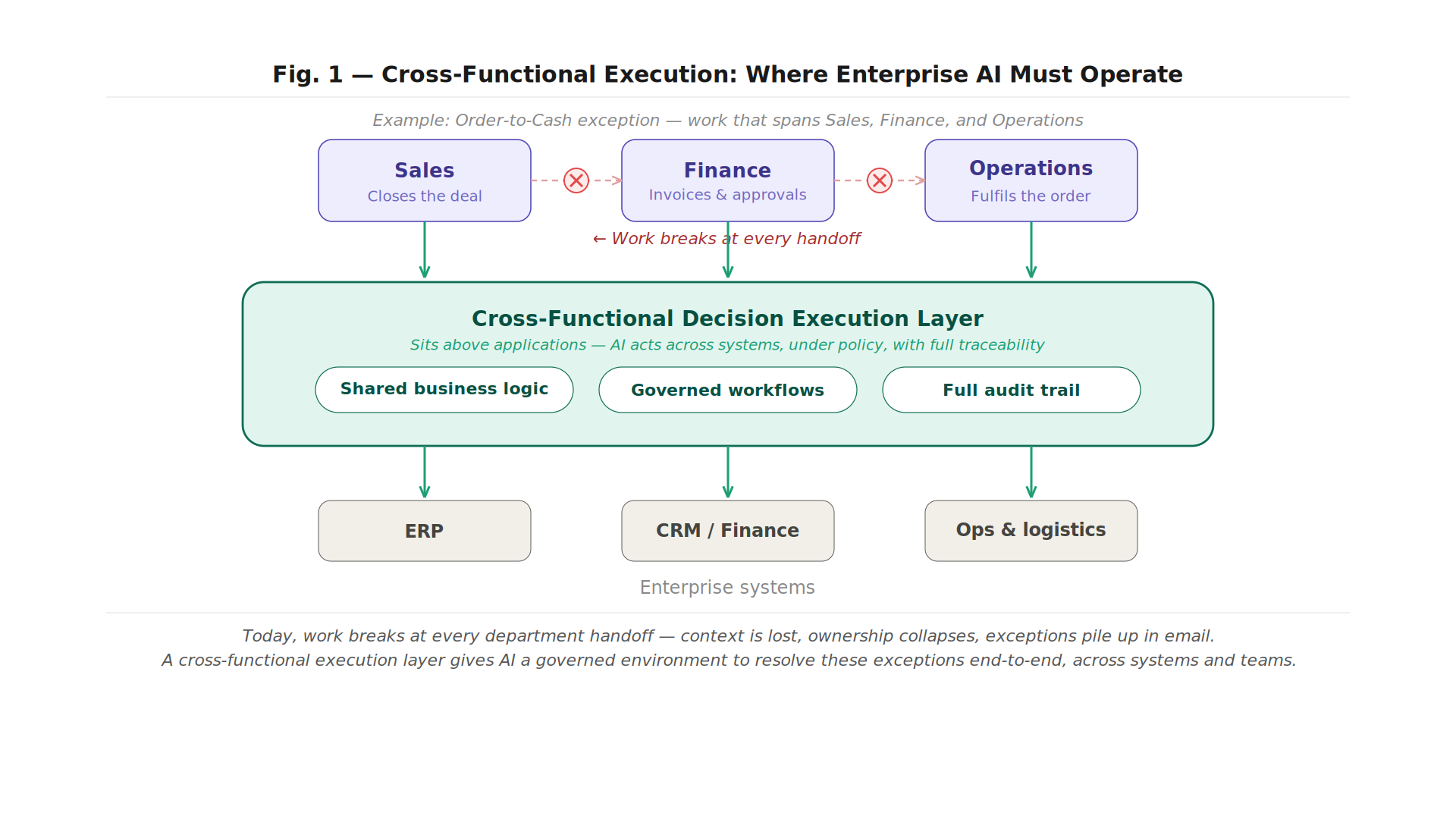
If you want to understand why enterprise AI stalls, look closely at the workflows that matter most. They almost always share the same characteristics: they span multiple departments, cut across several systems, are governed by policy, and are driven by exceptions rather than happy paths.
These are not edge cases.
They are the enterprise.
A deal is closed by Sales, but Finance cannot issue the invoice. There may be a credit hold, a pricing mismatch, a missing purchase order, or a delivery dispute.
What follows is not automation, but a prolonged sequence of emails, spreadsheets, approvals, and escalations across Sales, Finance, Operations, and Customer Success.
AI can explain what went wrong. The real value lies in whether it can resolve the issue end-to-end.
Invoices fail to match purchase orders or receipts. Tolerance rules vary by supplier, category, and region, and approvals depend on amount, risk, and delegation of authority.
Exceptions accumulate in inboxes.
AI can summarize the discrepancy, but resolution requires coordinated action across systems under explicit policy.
Reconciliations often live in spreadsheets. Definitions differ across teams, and late adjustments lack clear ownership.
Everyone trusts the numbers until they don’t.
AI can flag anomalies, but closing the books demands controlled, auditable execution across Finance, Accounting, and Operations.
Forecasts shift. Suppliers slip. Inventory is reallocated. Priority customers escalate.
Decisions must balance service levels, margins, contracts, and risk, and must do so quickly.
AI can analyze the trade-offs, but execution spans planning, sourcing, logistics, and commercial systems.
Across all of these cases, AI can help analyze the problem.
But analysis is not the bottleneck.
Execution is.
And execution, in the enterprise, means coordinating decisions across systems, teams, and policies, not generating yet another recommendation.
Execution is not clicking a button.
Execution means:
This is exactly where most enterprise stacks are weakest.
Because they were built assuming humans would do the coordination.
Most AI pilots succeed in isolation.
They fail the moment they encounter real enterprise operations: fragmented ownership, conflicting rules, unclear authority, and the absence of any system that spans departments.
As a result, organizations keep AI confined to the edges and rely on humans to bridge the gaps.
That is not transformation. It is the illusion of progress.
To make enterprise AI real, organizations need a layer most stacks don’t provide today.
A cross-functional decision execution layer that sits above applications.
A layer where:
Without this layer, enterprises are forced into a false choice: autonomy without control, or control without autonomy.
Cross-functional AI requires both.
If you are serious about enterprise AI, stop asking where you can add AI features.
Start asking a more difficult question:
Which cross-functional decisions are still being resolved manually?
Then begin with one exception-heavy workflow that genuinely matters. Make its rules, policies, and constraints explicit, and assess whether your current stack can allow AI to execute decisions safely under governance.
If it cannot, your organization is not AI-native ready, and it will not capture the real value of AI.
Enterprise AI will not be won inside chat windows or dashboards. It will be won in the hard, unglamorous work of resolving exceptions, coordinating across departments, enforcing policy, and executing decisions end to end.
That work is inherently cross-functional.
And that is why cross-functional execution defines the future of enterprise AI.
This gap is exactly why we built KAWA.
Not to add AI to existing tools, but to create an AI-native, governed decision layer above them, where intelligence can execute across systems, under policy, with traceability and control.
Because the future of enterprise AI isn’t about smarter models.
It’s about giving intelligence a system it can actually run on.

Connect your systems. Centralize your logic. Automate mission-critical operations
Connect your systems.
Centralize your logic.
Automate mission-critical operations
